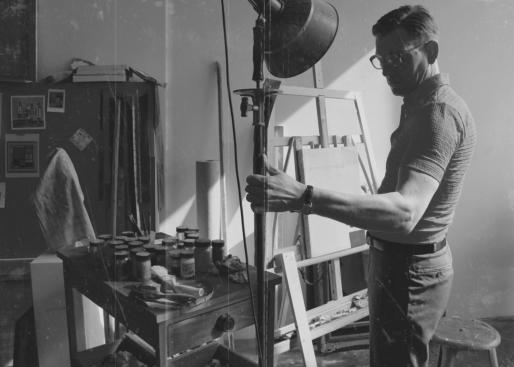
Estate of a fictional character
About Dirk Dietrich Hennig,
The Rudolf Collection, Sprengel Museum, Hanover
by Christina Irrgang in: on art MAGAZIN, 2023
Translated by Seth Widman
Only rarely does an exhibition appear in contemporary art
presentations that, against the background of various curatorial
concepts, does not want to convince with its uniqueness. However,
the exhibition "The Rudolf Collection" by the artist Dirk Dietrich
Hennig, which can be discovered in the Sprengel Museum Hannover,
is different: its appearance, which is reminiscent of countless
collection presentations of classical modernism in art museums,
expresses the essence of its intention, arranged between stretcher
frames and display cases.
The works hang neatly in a row and appear to be well-known to the
trained art historian or play on assumptions of knowledge and
recognition. The view moves through display cases and over bases
with raised sculptures to a brilliant presentation wall, which uses 28
works to represent the vocabulary of art history from avant-garde and
constructivism to Nouveau Réalisme. The pictures and objects are
lined with table display cases that tell of the life of the collector and art
forger Carl Gerhardt Rudolf - a fictional character and his 'oeuvre' that
fills the exhibition space in the Sprengel Museum and is the motif of
the sophisticated narrative by the artist Dirk Dietrich Hennig staged
here.
Hennig's story, which fills space and text, begins like this: The
historian, self-taught and captured person of the GDR regime Carl
Gerhardt Rudolf (born 1922 in Erfurt, died 2012 in Venice) is for the
previously unknown Department of Commercial Coordination: Modern
Art (MoK ), which existed in the context of the Commercial
Coordination Department (KoKo) of the GDR Ministry for Foreign
Trade initiated by Alexander Schalck-Golodkowski, worked as an
involuntary art forger for the purpose of obtaining foreign currency.
Rudolf, who operated under the code name Rembrandt, was
responsible for expanding an existing oeuvre of modern art through
forgeries and imitations of popular works by important artists in order
to serve various areas of the European art market. The reason why
Rudolf was chosen for this activity was his expertise as a historian, in
which he is said to have dealt with the phenomenon of the aura of
works of art according to Walter Benjamin and in the course of which
he had already made reproductions to support his own theses of
works of art. After his death in Venice, his estate was declared as a
suspected forgery through an attempted sale through an auction
house. Due to the massive destruction of files in the Ministry for State
Security (Stasi) around 1989, a complete reconstruction of the Rudolf
collection is no longer possible.
The artistic work of Dirk Dietrich Hennig (*1967) is characterized by
“historical interventions” such as these surrounding the figure Carl
Gerhardt Rudolf and his collection: For over 20 years, Hennig has
been creating characters, narratives and associated works and
artifacts, the “interventions in the historiography and additions to
historical processes as an artistic intervention”.(1) The list of figures
he invented and documented literary, visual and performative as well
as photographically documented by himself is long and at the same
time diverse, ranging from the 19th century to the present day, from
the composer, photographer and inventor of the camera Babám No. 1
Gustav Szathmáry (1867-1907) to the artist Jean Guillaume Ferrée
(1926-1974), who worked with photographic collaged “memory
images” in the Fluxus style, to the artist duo George Cup & Steve
Elliott (1930-2008/1933-1986), which he staged in the style of
American minimal art and light art.(2) The connection of many of his
figures is the work with the medium of photography. So it is not
surprising that when Hennig examines the art forger Carl Gerhardt
Rudolf, he now focuses equally on the theory of photography and the
reproducibility of images, based on the assumption that a work of art
that is captured through a lens is also one in its mediatized
appearance changed perspective and, as a result, subject to
reference.
In his artistic-performative analysis, Dirk Dietrich Hennig draws on
the essay The Work of Art in the Age of its Technical Reproducibility
by Walter Benjamin (first published in French in 1936), which he
initially published in one of the showcases in the context of the
exhibition as a reference for the work of Carl Gerhardt Rudolf exhibits
and comments on this in the texts accompanying the show. Hennig
not only bases the reading of his exhibition on a subtext - rather, he
brings a crucial aspect of his own artistic activity to the subject of
reflection. He skillfully conveys the boredom that arises when looking
at the pictures and sculptures he presents, which, as described at the
beginning, arises from an experience of returning to what has already
been seen: images that stick to the eye like distorted memories and
as something that has already been seen ' refer to somewhere else or
to a certain kind of arbitrariness. He transfers them into a process of
ascending analysis as he lays tracks that lead through a course of art
appreciation that he conceptually designed.
By linking the production of works of art as well as their forgery or
imitation to the photographic reproduction of works of art - also in
Benjamin's sense, where photographic reproduction and politics are
thought to be closely linked and artistic copying only led to power-
political and capitalist product values through the medium of
photography (3) - he brings the figure of Carl Gerhardt Rudolf and his
history together to critically examine artistry, the art market, art
reporting and the art system, which brings out the porous substance
of the subject in its sober representation. At the same time, Hennig
emphasizes that the copying or modification of a work of art has itself
become valid as a procedure. Because Hennig's artistic work and
body of work is not just about creating fictional illusions, but about the
facets of storytelling, which he enriches with (sometimes fictitious)
research materials such as fictitious press reports or fake personnel
files - and thus with one through that The medium of photography
enabled a new direction and reference to questions of artistic
production. When the artist formulates the thesis about the figure of
Rudolf that “[…] the work of art is a projection surface for the need for
significance […]”(4), he also underlines the multiple perspectives that
a projection surface creates through personal attributions of meaning
in a mirror effect go out and in turn generate needs that, according to
their calculation, become purchasable. It is not without reason that the
creation of needs has been able to continue for decades, primarily
through the borrowing of artistic vocabulary that has become
established on the art market.(5)
The aspects that Dirk Dietrich Hennig intersperses with his
exhibition The Rudolf Collection between pictures, objects, ephemera
and contextualizing books on the benches are diverse and clever.
Despite the displeasure you initially felt, you could actually spend
hours here observing, reading, comparing and thinking. The exhibition
shows once again how worthwhile it is to overcome the complacency
of art - in favor of a receptive and reflective view.
1) See Dirk Dietrich Hennig - Historical Interventions, Contemporary Art from
Lower Saxony, Volume 77, Wallstein Verlag, Göttingen 2022.
2) See ibid., pp. 75ff., 63ff., 51ff.
3) See Benjamin, Walter: The work of art in the age of its technical reproducibility,
in: ibid., The work of art in the age of its technical reproducibility - three studies on
the sociology of art, Suhrkamp Verlag, Frankfurt am Main 1977, pp. 7-44, here p.
18, 20, 28, 37.
4) leaflets accompanying the exhibition, Sprengel Museum Hannover.
5) See, for example, Wolfgang Beltracchi in: “Counterfeiters, fraudsters,
impostors – why do we like to fall for them so much?”, ZDF Aspects from
September 30, 2022, TC 19:31-23:59, https://www.zdf
.de/kultur/aspekte/hochstapler-kulturgeschichte-100.html, last accessed on
October 12, 2022.
© dirkdietrichhennig.com 2025